
Call money rate touches an intra-day peak of 30%.

India's economy grew by 1.6 per cent in the fourth quarter of 2020-21, restricting the full-year contraction to 7.3 per cent, official data showed on Monday. The fourth quarter growth was better than the 0.5 per cent expansion in the previous October-December quarter of 2020-21. The gross domestic product (GDP) had expanded by 3 per cent in the corresponding January-March period of 2019-20, according to data released by the National Statistical Office (NSO).

The markets had touched their highest levels in a month.
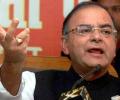
Jaitley said note ban has compelled people to deposit money into bank accounts.

'The recent price hike would only be beneficial if the airlines continue to operate at 80 per cent airline capacity. An increase towards 90 or 100 per cent airline capacity would again add pressure to the fares as demand remains muted. Also, we are in the fourth quarter of the fiscal year which is a seasonally weaker quarter,' says an analyst.

'Fiscal purists would quarrel with the idea of selling assets to pay for current expenditure -- such as the payout to farmers and the health insurance programme -- for the obvious reason that the process cannot go on forever.' 'At some point, the list of assets available for sale will run out,' notes T N Ninan.consultations -- something already aired in connection with the lease of airports to the Adani group, says T N Ninan.

The sector employs around 1 million skilled and unskilled workers directly and indirectly and decline in exports is a major worry for participants in the value chain.

Most brokerages have maintained their Sensex and Nifty targets as they believe there is little room for further re-rating in the backdrop of weak earnings.

The stock was the worst hit among Sensex and Nifty components.

Valued at $71.2 billion, the bank's market capitalisation is more than that of global banks like Barclays, JP Morgan Chase and Credit Suisse.

The need for larger investment in infrastructure that is the biggest shortcoming, says A V Rajwade.

These conditions are implementation of the 'One Nation, One Ration Card' scheme, ease of doing business, power sector reforms, and urban local body reforms.

2019 appears a story of two halves for Indian equities - a more difficult first half might precede a stronger second half, said Abhiram Eleswarapu, bottom, left, Head of India Equity Research, BNP Paribas in an interview with Ashley Coutinho.

In 2017, a consortium led by Russian state oil company Rosneft agreed to buy Essar Oil for $12.9 billion in India's biggest foreign acquisition of a homegrown company. Rosneft's buyout of Essar's assets was meant to herald a wave of energy investments in India - over six decades after Esso, Caltex and Shell invested in India's refining sector in the 1950s. But the government has tripped up in its efforts to sell Bharat Petroleum Corporation Ltd (BPCL), formerly Burmah Shell, a blue chip public sector company. Bidders include a couple of global funds and resources firm Vedanta.

That is what you will hear again after Nirmala Sitharaman presents a speech that will prove to be meaningless and numbers that will show themselves to be wildly off the mark, observes Aakar Patel.

The measures to reduce the current account deficit should have focused far more on narrowing the trade imbalance, principally through export facilitation and linked FDI, says Nitin Desai.

Foreign portfolio investors, on the other hand, have been net sellers in the markethaving pulled out Rs 8,600 crore
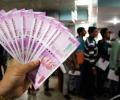
'This is not without risk because extraordinary steps taken in exceptional times have the habit of becoming habits until the next crisis intervenes,' warns T N Ninan.

'The belief that FDI will shift from China appears to be a strategy of politicians to keep the media busy, chasing irrelevant news to ward off pressure and questions about the government's plans to deal with COVID,' observes Debashis Basu.

The Constitution should not encumber these choices, specially limiting them to second-best or third-grade options.

Fresh buying by domestic institutional investors and better-than-expected June quarter results from some blue-chip companies boosted investor sentiment

Determining the direction of the dollar in Trump's America will be more critical for asset allocation than getting your call on interest rates right, says Akash Prakash.

'If the epidemic is sharply contained in a month or two, we have a huge buying opportunity. 'If not, we are staring at a serious economic crisis, the contours of which we are totally unaware of,' warns Debashis Basu.

With $120 billion worth of deals, 2018 was the best year on record. Many also blame frequent policy flip-flops and increasing tax scrutiny as big dampners for business.
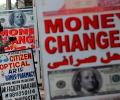
The Rupee is seen weakening further against the dollar.

The overseas market has developed into a significant competitor for India's two biggest markets -- rupee and stocks, the pre-Budget Economic Survey 2013-14 said, adding that ten years ago, the global market was practically absent in both these fields.

Concerned over decline in gold exports from SEZs following ban on its trading, the government has allowed units in these zones to export gold items after a minimum value addition of 3 per cent.

Close to 9 lakh registered companies are not filing annual returns with the ministry of corporate affairs and are a potential source of money laundering, Revenue Secretary Hasmukh Adhia said on Saturday.

Cancellation of at least Rs 3,000-crore worth of business has happened in the past few weeks.

The GDP slumped to a three-year low lagging China for the second straight quarter -- as manufacturing slowed ahead of the GST launch amid demonetisation effect.

Among top losers that dragged down key indices were Infosys, TCS, Reliance, SBI, Tata Steel and ITC, falling up to 2.15 per cent.

Shifting its stance of monetary policy towards targeting retail inflation as it is an "inequitable tax", RBI today said it may exceed 8 per cent by March end and efforts will continue to bring it down.

Demonetisation was not a good idea and the time should have been utilised instead to fine-tune the Goods and Services Tax before it was introduced, said Gita Gopinath, John Zwaanstra Professor of International Studies and of Economics at Harvard University, in an interview with Advait Rao Palepu.

Financials were among the top losers along with Sun Pharma and index heavyweight Reliance Industries

The government on Monday forecast annual economic growth to accelerate to 7.4 per cent in the fiscal year ending in March 2015

IIM-B, professor R Vaidyanathan talks to Shobha Warrier about black money, Mudra Bank and Jaitley's Budget.

'As for tricky relations with China, India needs less of summitry type event management and more anticipatory analysis and management of events,' says Ambassador Jaimini Bhagwati.

'Trump's anti-trade, anti-immigrant rhetoric reminds me of Chinese history,' says A V Rajawade.
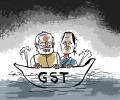
Retaining the GST rate assumes importance since states are under pressure to increase their revenues, hit hard by lockdown. Also, the Centre has not fully compensated states for their revenue losses on account of GST for 2019-20.
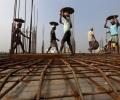
With this India will continue to retain the position of being the fastest growing emerging economy. And by 2021, its growth rate is projected to be 1.5 per cent more than China's 6 per cent.
